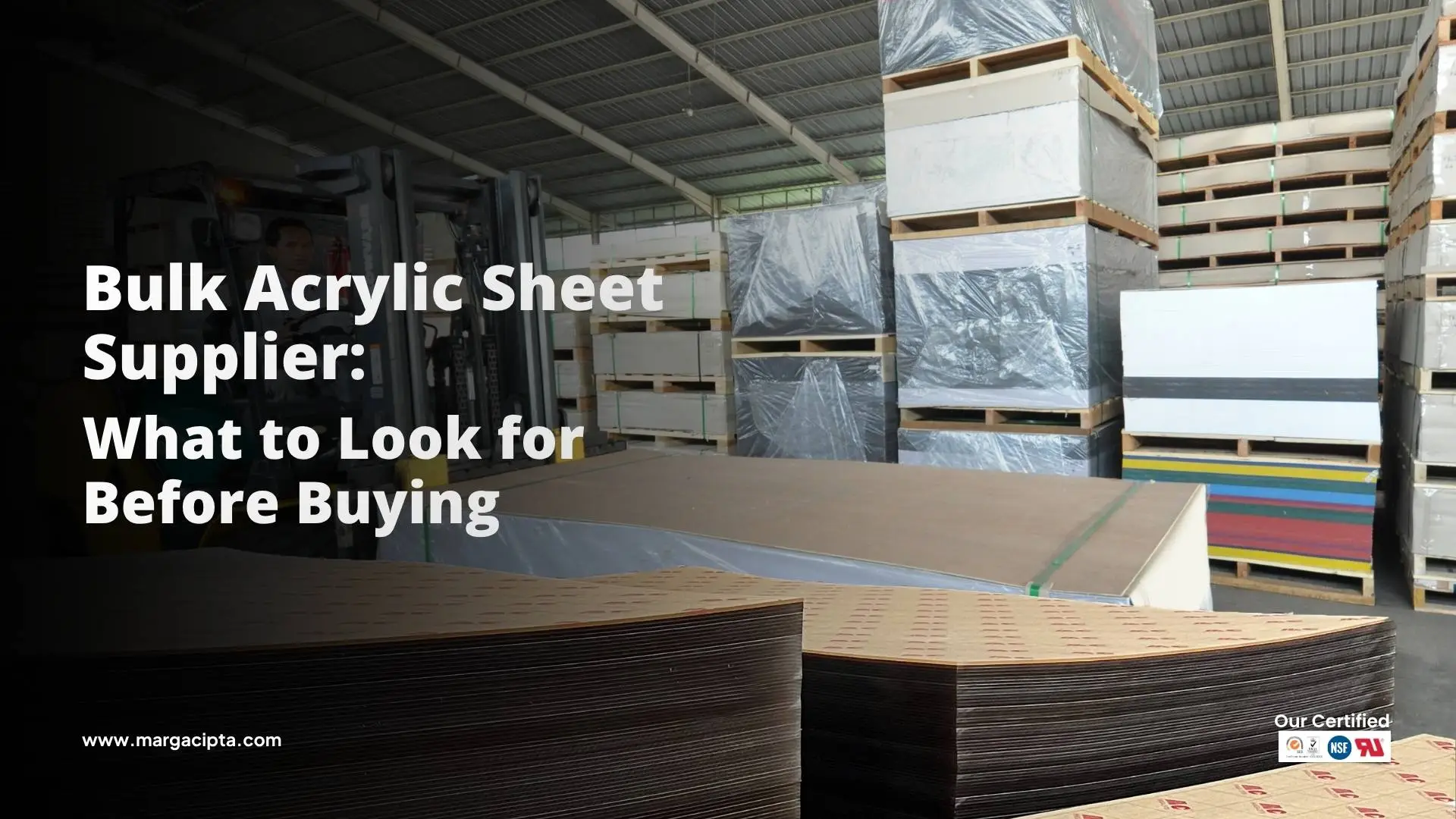
Bulk Acrylic Sheet Supplier: What to Look for Before Buying

Informational

Choosing the right bulk acrylic sheet supplier is essential for ensuring consistent product quality, reliable supply, and long-term business success. 

Whether you're a distributor, manufacturer, fabricator, or commercial buyer, partnering with a trusted supplier helps improve production efficiency while reducing material-related issues.

Before purchasing acrylic sheets in bulk, it's important to evaluate more than just pricing.

Why Choosing the Right Supplier Matters

Bulk purchases often support ongoing production or large-scale projects.

A reliable supplier helps ensure:

  • Consistent material quality
  • Stable inventory availability
  • Reliable delivery schedules
  • Technical product support
  • Better long-term value

Working with the right supplier can reduce production delays and minimize material waste.

Read also: Acrylic Sheet Price Factors: What Affects the Cost of Acrylic Sheets?

1. Product Quality

The first factor to evaluate is the quality of the acrylic sheets.

High-quality acrylic should provide:

  • Excellent optical clarity
  • Consistent thickness
  • Smooth surfaces
  • Reliable durability
  • Stable color consistency

Consistent material quality contributes to better fabrication results and improved product performance.

2. Product Range

A supplier with a comprehensive product portfolio can better support different project requirements.

Look for suppliers offering:

  • Clear acrylic sheets
  • Colored acrylic sheets
  • Satin acrylic
  • Frosted acrylic
  • Various thicknesses and sheet sizes

A wider selection allows greater flexibility across multiple applications.

3. Manufacturing Standards

Reliable suppliers maintain strict manufacturing standards to ensure consistency from one batch to another.

Consistent production quality helps reduce:

  • Material defects
  • Fabrication issues
  • Dimensional variations
  • Color inconsistencies

This is especially important for businesses handling repeat orders.

4. Supply Reliability

A dependable supplier should be able to maintain stable inventory and deliver products on schedule.

Reliable supply helps businesses avoid:

  • Production interruptions
  • Delayed customer deliveries
  • Emergency material sourcing

Consistency is particularly important for manufacturers and distributors purchasing in bulk.

5. Technical Support

Experienced suppliers should be able to assist customers with product selection based on application requirements.

This may include recommendations regarding:

  • Acrylic type
  • Sheet thickness
  • Surface finish
  • Fabrication compatibility

Technical guidance helps buyers select the most appropriate material for their projects.

6. Long-Term Value

While price is an important consideration, the lowest price does not always provide the best value.

Premium acrylic sheets often deliver:

  • Better durability
  • Improved fabrication performance
  • Lower defect rates
  • Longer service life

Evaluating overall value rather than price alone helps support better purchasing decisions.

Read also: How to Bend Acrylic Sheet: Methods, Tools, and Best Practices

Why Choose Marga Cipta

Marga Cipta is a trusted manufacturer of premium cast acrylic sheets, serving customers across various industries.

Our acrylic sheets are suitable for:

  • Signage
  • Retail displays
  • Interior design
  • Industrial fabrication
  • Architectural applications
  • Custom manufacturing

With consistent quality and a wide range of product options, Marga Cipta supports businesses requiring reliable acrylic materials for bulk purchases.

Conclusion

Selecting the right bulk acrylic sheet supplier involves evaluating product quality, manufacturing consistency, technical expertise, and long-term reliability—not just price.

Partnering with a trusted supplier helps businesses achieve better production efficiency and consistent product quality across every project.

Partner with Marga Cipta for Premium Acrylic Sheets

Looking for a reliable bulk acrylic sheet supplier? Marga Cipta offers premium cast acrylic sheets in various sizes, thicknesses, and finishes to support your business needs.

For inquiries or bulk orders, email info@margacipta.com.

For product information, project inspiration, and the latest updates, follow Instagram @margacipta.
News Release

Acrylic vs Polycarbonate: Full Comparison

When choosing the right plastic material for your project, the debate between acrylic vs polycarbonate often comes up. 

Both materials are widely used in industries such as construction, signage, and manufacturing, but they have distinct characteristics that make them suitable for different applications.

Acrylic Versus Polycarbonate

Understanding their differences can help you make a more informed decision based on performance, durability, and cost.

1. Strength and Impact Resistance

One of the key differences between acrylic and polycarbonate lies in their strength, but for most applications, acrylic already offers more than enough durability.

Acrylic is a strong and rigid material, even stronger than glass in many cases, making it highly reliable for everyday use. Its solid structure allows it to maintain shape and stability, which is especially important for applications like displays, signage, partitions, and decorative panels.

While polycarbonate is often highlighted for its extreme impact resistance, this level of durability is typically only necessary for high-stress or industrial applications. For general commercial and design purposes, acrylic provides the ideal balance between strength and functionality.

Read also: How to Identify High-Quality Cast Acrylic Sheets

2. Clarity and Aesthetics

If visual clarity is your top priority, acrylic is the clear winner. Acrylic sheets offer exceptional optical clarity, often compared to glass, with a light transmission rate of up to 92%.

This makes it ideal for applications such as retail displays, aquariums, and architectural elements.

Polycarbonate is slightly less clear and may have a subtle haze. While still transparent, it does not provide the same premium look as acrylic.

3. Scratch Resistance

Acrylic has better natural scratch resistance compared to polycarbonate. This makes it more suitable for applications where surface appearance is important.

Polycarbonate, while stronger, is more prone to scratches and often requires additional coatings to maintain its appearance over time.

4. Weather and UV Resistance

Acrylic performs very well in outdoor environments. It has excellent UV resistance and does not yellow easily, making it a great choice for outdoor signage, skylights, and decorative panels.

Polycarbonate can also be used outdoors but usually requires UV coating to prevent yellowing and degradation over time.

5. Workability and Fabrication

Acrylic is easier to cut, polish, and thermoform. It provides clean edges and a glossy finish, making it a favorite for design-focused applications.

Polycarbonate is more flexible and harder to crack during fabrication, but it can be more challenging to achieve a polished, high-end finish.

Read also: Acrylic for Industrial Use: From Machine Guards to Safety Barriers

6. Cost Consideration

In general, acrylic is more affordable than polycarbonate. If budget is a key factor and extreme impact resistance is not required, acrylic is often the more cost-effective option.

Polycarbonate tends to be more expensive due to its superior strength and durability.

Conclusion

The choice between acrylic vs polycarbonate ultimately depends on your project needs. If you prioritize clarity, aesthetics, and cost-efficiency, acrylic is the better option. However, if impact resistance and durability are critical, polycarbonate is the superior material.

For most commercial and design applications, acrylic offers the best balance between performance and visual appeal.

Ready to explore your clear cast acrylic options? At Margacipta Wirasentosa, we offer high-quality clear cast acrylic sheets from 100% virgin MMA in various thicknesses and custom sizes to fit your needs.

Reach to our Instagram or download our Product Catalog for more information.

Acrylic vs Tempered Glass: A Complete Comparison

When comparing acrylic vs tempered glass, acrylic is generally the better choice for applications requiring lightweight construction, design flexibility, and impact resistance, while tempered glass is preferred for environments that demand superior scratch resistance and heat tolerance.

Although both materials offer excellent transparency, they differ significantly in weight, durability, fabrication, and cost. Understanding these differences helps businesses, designers, and fabricators select the most suitable material for their projects.

Acrylic vs Tempered Glass at a Glance

Here's a quick comparison.

Feature Acrylic Tempered Glass
Transparency Excellent Excellent
Weight Lightweight Heavy
Impact Resistance High Moderate
Scratch Resistance Moderate Excellent
Fabrication Easy Limited
Custom Shapes Excellent Difficult
Breakage Less likely to shatter Can shatter into small pieces

Both materials have strengths, but the best option depends on the intended application.

Read also: Best Acrylic Thickness for Ornaments: Size Guide for Perfect Results

Weight

One of acrylic's biggest advantages is its lightweight construction.

Acrylic sheets weigh approximately half as much as glass, making them easier to:

  • Transport
  • Install
  • Handle
  • Fabricate

For large signage, exhibition booths, and retail displays, this weight reduction can significantly lower installation effort and transportation costs.

Impact Resistance

Although tempered glass is much stronger than standard glass, acrylic generally offers higher impact resistance.

If subjected to accidental impact, acrylic is less likely to shatter into fragments.

This makes acrylic suitable for:

  • Retail displays
  • Protective barriers
  • Machine guards
  • Product showcases
  • Public display systems

Optical Clarity

Both materials provide excellent transparency.

Premium cast acrylic offers exceptional optical clarity that closely resembles glass while maintaining a lighter structure.

For many commercial applications, customers experience little visual difference between high-quality acrylic and tempered glass.

Fabrication Flexibility

Acrylic is significantly easier to fabricate.

It can be:

  • Laser cut
  • CNC machined
  • Thermoformed
  • Engraved
  • UV printed
  • Polished

Tempered glass, however, must be cut and processed before the tempering process. Once tempered, it cannot be drilled or reshaped.

This makes acrylic the preferred material for custom fabrication projects.

Cost Considerations

Project cost extends beyond the material price.

Because acrylic is lighter and easier to fabricate, businesses often benefit from:

  • Lower transportation costs
  • Faster installation
  • Reduced breakage risk
  • More affordable customization

These advantages can improve the overall cost efficiency of a project.

Common Applications

Acrylic

Ideal for:

  • Signage
  • Retail displays
  • Exhibition booths
  • Product displays
  • Interior design
  • Decorative panels

Tempered Glass

Commonly used for:

  • Shower enclosures
  • Building windows
  • Glass doors
  • Safety glazing
  • Architectural installations

Read also: Laser Cut Acrylic Sheet: Benefits, Applications, and Design Tips

Why High-Quality Acrylic Matters

The performance of acrylic depends on its quality.

Premium cast acrylic sheets provide:

  • Superior clarity
  • Better weather resistance
  • Consistent thickness
  • Excellent fabrication performance
  • Long-lasting durability

Marga Cipta manufactures premium cast acrylic sheets suitable for signage, displays, architecture, industrial fabrication, and custom projects.

Conclusion

When comparing acrylic vs tempered glass, acrylic offers greater versatility, lighter weight, and easier fabrication, making it the preferred material for many commercial and design applications.

For projects requiring custom fabrication, premium appearance, and long-term performance, high-quality acrylic sheets provide an excellent solution.

Source Premium Acrylic Sheets from Marga Cipta

Marga Cipta supplies premium cast acrylic sheets in various thicknesses, colors, and finishes for signage, displays, architectural projects, and custom fabrication.

For inquiries or orders, email info@margacipta.com.

For product updates, inspiration, and application ideas, follow Instagram @margacipta.

MARGA CIPTA is announce the addition of Pantone's 2023

From the vibrant and bold, to the classic and traditional, color has the power to evoke an emotional response. MARGA CIPTA has been a leader in providing our customers with the highest quality cast acrylic sheet products. We are pleased to announce the addition of Pantone's 2023 Color of the Year, Viva Magenta 18-1750.

Viva Magenta will be perfect for a variety of applications, from color-coding locations and items to make the most of your space. We encourage you to explore all of our acrylic products.

Fabricators, designers, architects and retail clients expect consistency and quality and Marga Cipta's high optical quality acrylic product, great customer service and a responsive production team is your perfect supplier partner.

For more info contact us or your account rep for more details and current prices

The Global Roller Coaster – Closed for the Season?

May 10, 2019May 11, 2019 mcwsi


Are the days of monthly acrylic price creep behind us? Are we entering a period of regular price drops? Will price stability level the playing field and reduce the risks of pricing shenanigans? Here we are, one year after our 2018 Global MMA Roller Coaster assessment considering the impact of a reverse pricing trajectory that is challenging purchasing and marketing managers throughout the supply chain.


MMA prices (methyl methacrylate, the raw material used to produce a wide range of products distributed by IAPD members) have declined about 25% since their 2018 peak levels. Some distributors are enjoying richer profit margins while others are losing market share to aggressive players betting the decline will continue.


In short, soft demand, over supply of MMA and the possible threat of trade war tariffs at most levels of the supply chain have played a part in the current trends. Since the 1st Qtr ’19, prices in China have not decreased further indicating some stability. The South East Asian markets, however, continue to show weakness that point to further declines. In fact, we anticipate another price drop in May as South East Asian MMA demand is still oversupplied.


While stocks and output seem to have completed the needed adjustments during the 1st Qtr, the overall softer market does not warrant any price rebound. Any further price drops should not reach the magnitude of the previous quarter. We have probably hit bottom and any China price increase will be offset by other markets.


In the U.S., fires at some Lucite tanks will disrupt domestic supply. The same situation is affecting Brazil. Once those suppliers replenish, and barring any further unforeseen events, prices should remain level through the end of the year.


MARGACIPTA, Asia’s largest cell cast manufacturer, closely monitors MMA prices on a regular basis in order to provide our clients with the latest pricing data. Keep in touch with us or your sales reps as you manage your inventory positions and make smarter purchasing and marketing decisions possible.


Acrylic, MMA Acrylic, Asia, Global MMA, internatiional, MMA, pricing